Amany Atef
Agentic AI Use Cases and Real-World Examples in 2026
AI is no longer just supporting work, it is starting to run it.
In 2026, the rise of Agentic AI marks a fundamental shift from passive tools to autonomous systems that can think, decide, and act. The question is no longer whether AI can help, but whether it can take ownership of entire workflows.
Organizations today are moving beyond experimentation and asking:
👉 Can AI run this process end-to-end?
This is where Agentic AI is redefining how work gets done.
What is Agentic AI?
Agentic AI refers to intelligent systems designed as autonomous agents that can:
- Understand goals
- Make decisions
- Take actions
- Learn from outcomes
> all with minimal human intervention.
These systems operate with context awareness, adaptability, and goal orientation, transforming AI from a tool into a digital workforce partner.
As highlighted: Agentic AI systems can gather information, analyze data, make decisions, and take actions toward completing a defined objective
Why Agentic AI Matters Now
The shift is already underway at enterprise scale:
- By 2028, 33% of enterprise applications will include agentic AI
- By 2029, up to 80% of customer service issues may be resolved autonomously
- Organizations are evolving from automation → orchestration → autonomy
This is not just another AI trend, it’s a new operating model for organizations.
How Agentic AI Works?
Agentic AI operates through a continuous intelligent loop:
- Perceive
Collects and processes data from systems and environments
- Reason
Uses LLMs and enterprise data to make decisions
- Act
Executes tasks across platforms and tools
- Learn
Continuously improves through feedback loops
This enables systems to adapt dynamically, not just follow predefined rules.
Agentic AI vs Traditional AI
| Agentic AI | Traditional AI |
| Goal-driven | Task-driven |
| Autonomous decisions | Rule-based |
| Adaptive learning | Static behavior |
| End-to-end workflows | Isolated tasks |
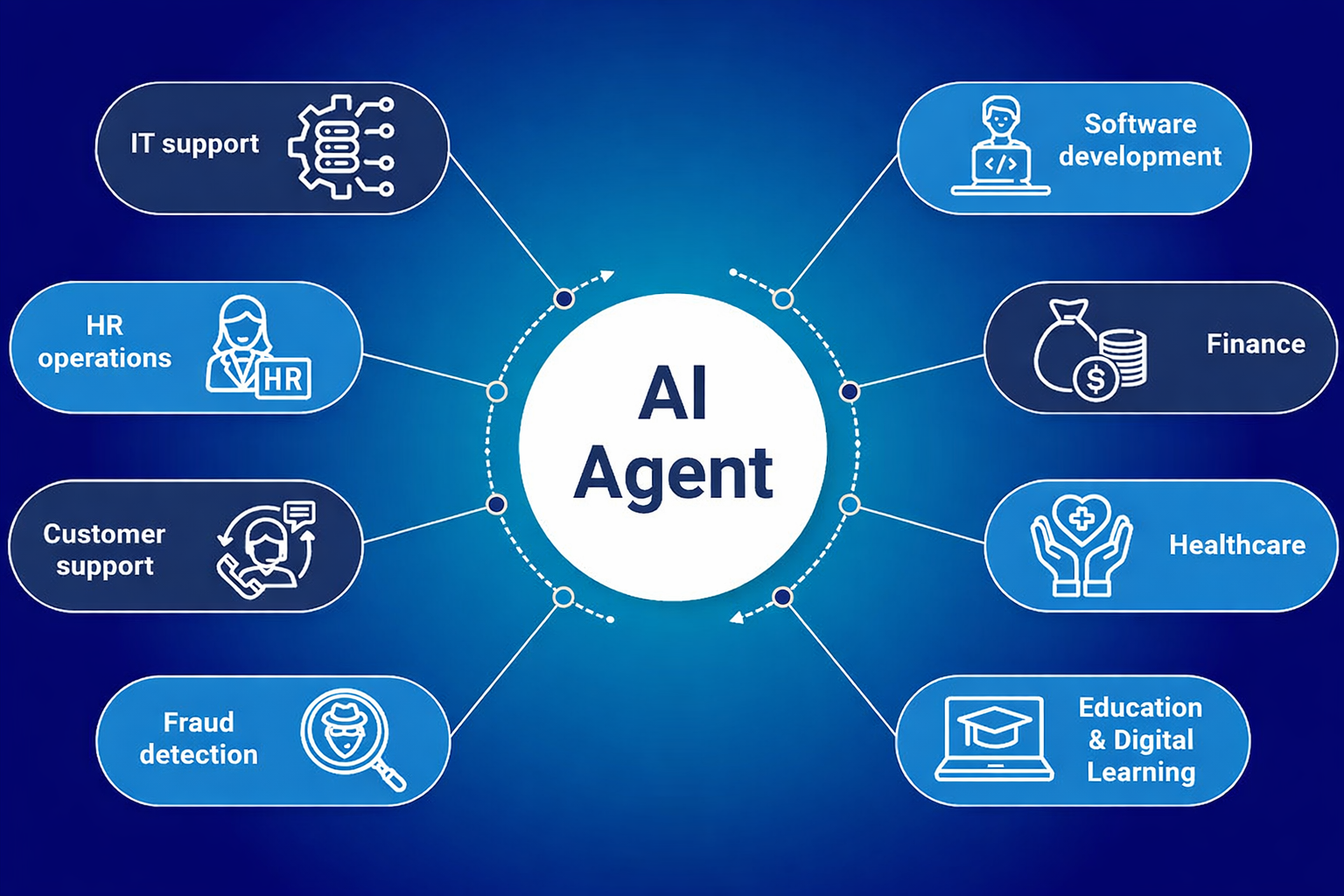
Top Agentic AI Use Cases (2026)
1. IT Operations & Service Management
Impact: Proactive issue resolution, automated support, reduced downtime
2. HR & Employee Experience
Impact: Automated recruitment, real-time employee support, personalized development
3. Customer Support & Experience
Impact: Intelligent conversations, proactive issue resolution, improved satisfaction
4. Cybersecurity & Fraud Detection
Impact: Real-time threat detection, automated response, risk prevention
5. Software Development (AI-Driven Engineering)
Impact: Faster releases, automated debugging, improved code quality
Industry-Specific Use Cases
Finance
Automated compliance, fraud detection, and personalized financial insights
👉 Outcome: Smarter financial decisions
Healthcare
AI-powered monitoring, virtual assistants, and predictive care
👉 Outcome: Better patient outcomes and efficiency
Legal
Automated case handling and compliance monitoring
👉 Outcome: Faster and more accurate legal operations
Education & Digital Learning (AI-Powered Learning Ecosystems)
The Challenge:
Traditional learning systems remain static, fragmented, and content-driven, with limited personalization and weak linkage to workforce outcomes.
Learners often experience:
- One-size-fits-all content
- Low engagement
- Limited connection between learning and career growth
At the same time, institutions lack real-time visibility into skills, gaps, and impact.
How Agentic AI is Transforming Learning:
Agentic AI is shifting education from content delivery → capability orchestration.
Personalized Learning Pathways at Scale
AI agents:
- Assess skills, roles, and goals
- Recommend adaptive learning journeys
- Continuously adjust learning paths
👉 Learning becomes dynamic and outcome-driven
AI Learning Coaches (Always-On Mentors)
AI-powered assistants:
- Guide learners step by step
- Provide instant feedback
- Motivate and nudge learners
👉 Acting as 24/7 personalized mentors
Skills Intelligence & Workforce Insights
AI agents:
- Identify skill gaps
- Predict future needs
- Support strategic workforce planning
👉 Learning becomes data-driven and strategic
Automated Learning Operations
Agentic AI automates:
- Course recommendations
- Enrollment and pathways
- Assessment and feedback
👉 Reducing operational complexity
Learning in the Flow of Work
AI integrates learning into daily tools:
- Provides knowledge at the moment of need
- Embeds learning into workflows
👉 Learning becomes continuous and seamless
Real-World Direction (2026 and Beyond):
Leading institutions are moving toward:
- AI-powered national learning platforms
- Skills-based workforce ecosystems
- Learning as Digital Public Infrastructure (DPI)
This transforms learning into a strategic capability engine, not just a training function.
Real-World Examples of Agentic AI
Johnson & Johnson
👉 Accelerating drug discovery through autonomous systems
Moody’s
👉 Multi-agent financial analysis improving decision accuracy
eBay
👉 AI agents enhancing development and marketplace efficiency
Deutsche Telekom
👉 AI-powered employee support at scale
Cosentino
👉 Digital workforce delivering 3–4x productivity gains
The Strategic Value of Agentic AI
Agentic AI is not just about efficiency, it’s about redefining how organizations operate.
Key Benefits:
- End-to-end automation
- Real-time intelligent decision-making
- Hyper-personalization
- Continuous, autonomous operations
It shifts AI from:
👉 Supporting work → Driving outcomes
Final Thought: From AI Tools to AI Teammates
The true breakthrough of Agentic AI is simple:
AI is no longer just a tool, it’s becoming a digital teammate.
Organizations that embrace this shift early will:
- Operate faster
- Decide smarter
- Scale effortlessly
The question is no longer “Should we adopt AI?”
It’s:
👉 “How fast can we build an agent-driven enterprise?”
Designed with WordPress
 The Smart Learning Expert: Insights and Innovations