From Tools to Teammates: Agentic AI Driving Smarter Workflows

Amany Atef

Agentic AI Use Cases and Real-World Examples in 2026

AI is no longer just supporting work, it is starting to run it.

In 2026, the rise of Agentic AI marks a fundamental shift from passive tools to autonomous systems that can think, decide, and act. The question is no longer whether AI can help, but whether it can take ownership of entire workflows.

Organizations today are moving beyond experimentation and asking:

👉 Can AI run this process end-to-end?

This is where Agentic AI is redefining how work gets done.

What is Agentic AI?

Agentic AI refers to intelligent systems designed as autonomous agents that can:

  • Understand goals
  • Make decisions
  • Take actions
  • Learn from outcomes

> all with minimal human intervention.

These systems operate with context awareness, adaptability, and goal orientation, transforming AI from a tool into a digital workforce partner.

As highlighted: Agentic AI systems can gather information, analyze data, make decisions, and take actions toward completing a defined objective

Why Agentic AI Matters Now

The shift is already underway at enterprise scale:

  • By 2028, 33% of enterprise applications will include agentic AI
  • By 2029, up to 80% of customer service issues may be resolved autonomously
  • Organizations are evolving from automation → orchestration → autonomy

This is not just another AI trend, it’s a new operating model for organizations.

How Agentic AI Works?

Agentic AI operates through a continuous intelligent loop:

  1. Perceive

Collects and processes data from systems and environments

  • Reason

Uses LLMs and enterprise data to make decisions

  • Act

Executes tasks across platforms and tools

  • Learn

Continuously improves through feedback loops

This enables systems to adapt dynamically, not just follow predefined rules.

Agentic AI vs Traditional AI

Agentic AITraditional AI
Goal-drivenTask-driven
Autonomous decisionsRule-based
Adaptive learningStatic behavior
End-to-end workflowsIsolated tasks

Top Agentic AI Use Cases (2026)

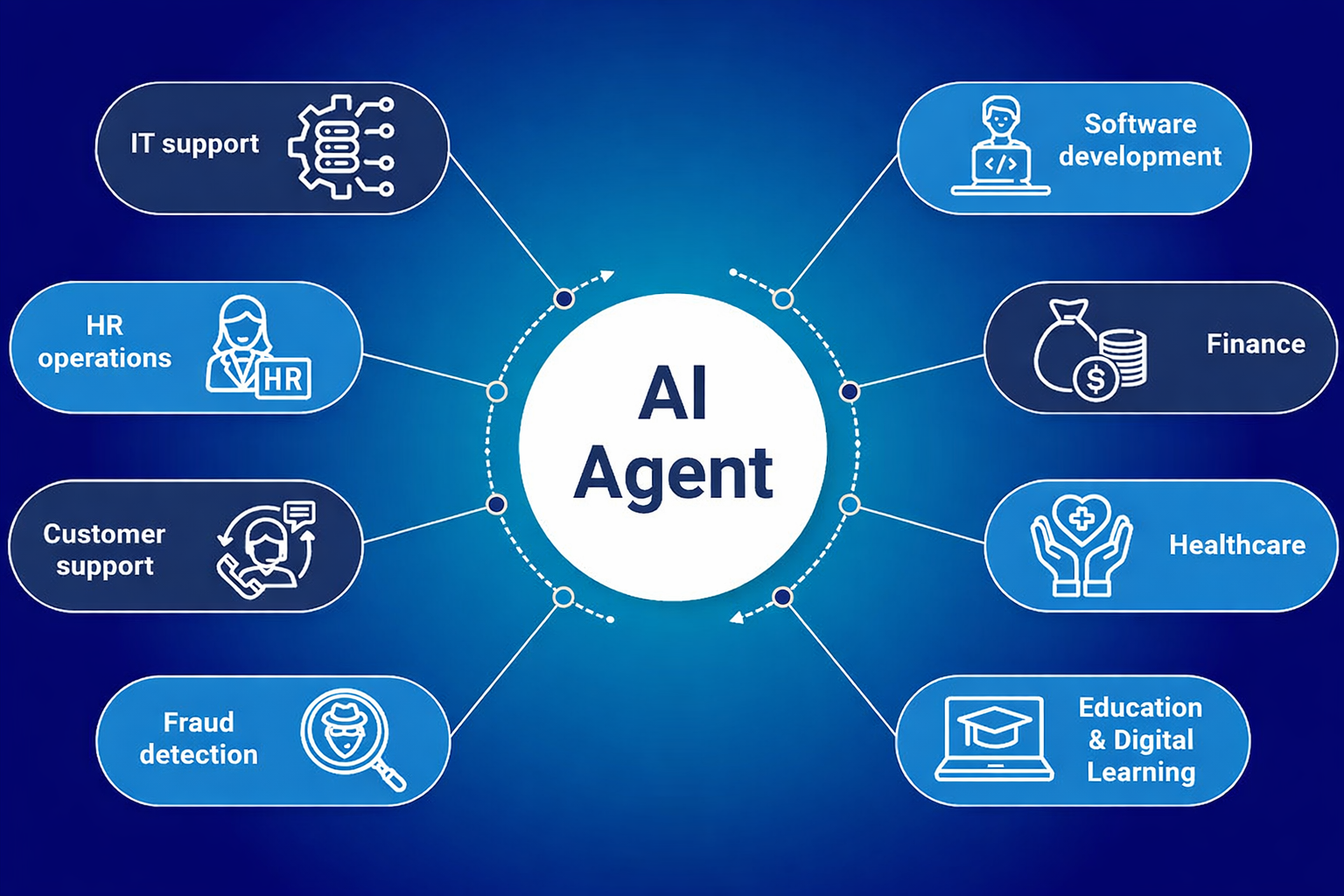
1. IT Operations & Service Management

Impact: Proactive issue resolution, automated support, reduced downtime

2. HR & Employee Experience

Impact: Automated recruitment, real-time employee support, personalized development

3. Customer Support & Experience

Impact: Intelligent conversations, proactive issue resolution, improved satisfaction

4. Cybersecurity & Fraud Detection

Impact: Real-time threat detection, automated response, risk prevention

5. Software Development (AI-Driven Engineering)

Impact: Faster releases, automated debugging, improved code quality

Industry-Specific Use Cases

Finance

Automated compliance, fraud detection, and personalized financial insights
👉 Outcome: Smarter financial decisions

Healthcare

AI-powered monitoring, virtual assistants, and predictive care
👉 Outcome: Better patient outcomes and efficiency

Legal

Automated case handling and compliance monitoring
👉 Outcome: Faster and more accurate legal operations

Education & Digital Learning (AI-Powered Learning Ecosystems)

The Challenge:
Traditional learning systems remain static, fragmented, and content-driven, with limited personalization and weak linkage to workforce outcomes.

Learners often experience:

  • One-size-fits-all content
  • Low engagement
  • Limited connection between learning and career growth

At the same time, institutions lack real-time visibility into skills, gaps, and impact.

How Agentic AI is Transforming Learning:

Agentic AI is shifting education from content delivery → capability orchestration.

Personalized Learning Pathways at Scale

AI agents:

  • Assess skills, roles, and goals
  • Recommend adaptive learning journeys
  • Continuously adjust learning paths

👉 Learning becomes dynamic and outcome-driven

AI Learning Coaches (Always-On Mentors)

AI-powered assistants:

  • Guide learners step by step
  • Provide instant feedback
  • Motivate and nudge learners

👉 Acting as 24/7 personalized mentors

Skills Intelligence & Workforce Insights

AI agents:

  • Identify skill gaps
  • Predict future needs
  • Support strategic workforce planning

👉 Learning becomes data-driven and strategic

Automated Learning Operations

Agentic AI automates:

  • Course recommendations
  • Enrollment and pathways
  • Assessment and feedback

👉 Reducing operational complexity

Learning in the Flow of Work

AI integrates learning into daily tools:

  • Provides knowledge at the moment of need
  • Embeds learning into workflows

👉 Learning becomes continuous and seamless

Real-World Direction (2026 and Beyond):

Leading institutions are moving toward:

  • AI-powered national learning platforms
  • Skills-based workforce ecosystems
  • Learning as Digital Public Infrastructure (DPI)

This transforms learning into a strategic capability engine, not just a training function.

Real-World Examples of Agentic AI

Johnson & Johnson

👉 Accelerating drug discovery through autonomous systems

Moody’s

👉 Multi-agent financial analysis improving decision accuracy

eBay

👉 AI agents enhancing development and marketplace efficiency

Deutsche Telekom

👉 AI-powered employee support at scale

Cosentino

👉 Digital workforce delivering 3–4x productivity gains

The Strategic Value of Agentic AI

Agentic AI is not just about efficiency, it’s about redefining how organizations operate.

Key Benefits:

  • End-to-end automation
  • Real-time intelligent decision-making
  • Hyper-personalization
  • Continuous, autonomous operations

It shifts AI from:

👉 Supporting workDriving outcomes

Final Thought: From AI Tools to AI Teammates

The true breakthrough of Agentic AI is simple:

AI is no longer just a tool, it’s becoming a digital teammate.

Organizations that embrace this shift early will:

  • Operate faster
  • Decide smarter
  • Scale effortlessly

The question is no longer “Should we adopt AI?”
It’s:

👉 “How fast can we build an agent-driven enterprise?”

Designed with WordPress
Learn Smarter, Not Harder: How ChatGPT Can Transform Your Learning Experience!


Introduction

ChatGPT can serve as your personal learning buddy and teaching assistant. By using the right prompts, you can save time, increase your learning and earnings, and enjoy your work more. OpenAI’s flagship platform excels at facilitating learning, acting like a tutor, comprehensive textbook, or wise mentor—only much faster. With a bit of guidance—specifically in mastering prompt writing—ChatGPT can help you learn new things significantly more efficiently than traditional methods. Here are my favorite ways to use ChatGPT for learning, enabling you to master any subject 100X faster!

Here you Go…. 😉

1. Research Assistance

Research is a cornerstone of effective learning, and ChatGPT excels in this area. By leveraging its extensive knowledge base, ChatGPT can provide reliable sources and key concepts for any topic you are studying.

Prompts:

  • What are some key terms I should know about [topic]?
  • Provide me with some reliable sources to learn about [topic].
  • Act as a research assistant and provide me with five reliable sources on [topic].

Example:
If you’re studying climate change, ChatGPT can offer sources, define key terms, and highlight important concepts, making your research process more efficient and thorough.

2. Definitions and Explanations

Understanding new terms and concepts is crucial for learning. ChatGPT can provide clear, concise definitions and explanations, along with real-world examples to enhance comprehension.

Prompts:

  • What does [term] mean?
  • Can you explain [concept] to me?
  • Define [term] and provide an example.

Example:
For instance, if you’re learning about “blockchain,” ChatGPT can define the term, explain its significance, and provide examples of its applications.

3. Answering Specific Questions

When you’re unsure about a specific concept or idea, ChatGPT can provide detailed answers to your questions, helping you understand complex topics better.

Prompts:

  • What are the best practices for [topic]?
  • What are the advantages and disadvantages of [concept]?
  • Can you give me some examples of [topic] in real life?

Example:
If you’re curious about the benefits of renewable energy, ChatGPT can list advantages, provide case studies, and suggest best practices for implementation.

4. Summarizing Complex Topics

Digesting large volumes of information can be overwhelming. ChatGPT can summarize articles, books, or complex ideas into more manageable pieces.

Prompts:

  • Describe the main points of [book] in a few sentences.
  • Craft a brief summary of [topic].
  • Summarize in a few short sentences: [sentence].

Example:
For a lengthy research paper on quantum computing, ChatGPT can distill the key points, making it easier for you to grasp the essential information quickly.

5. Learning New Skills

ChatGPT can provide step-by-step instructions, tips, and exercises for learning new skills, from languages to technical abilities.

Prompts:

  • Give me step-by-step instructions on how to learn [skill].
  • Explain the basics of [subject] for beginners.
  • Can you provide me with some exercises to practice [skill]?

Example:
If you’re learning Spanish, ChatGPT can offer vocabulary exercises, pronunciation tips, and grammar rules to help you progress.

6. Recommending Resources

Beyond answering questions, ChatGPT can suggest books, articles, apps, and other resources to deepen your knowledge on any subject.

Prompts:

  • Give me some book recommendations on [topic].
  • Can you recommend some blogs to follow for [topic]?
  • Suggest three apps for learning [language].

Example:
For someone interested in digital marketing, ChatGPT can recommend the latest books, influential blogs, and useful apps to enhance their learning.

7. Exploring Related Topics

To gain a comprehensive understanding, exploring related subjects is essential. ChatGPT can help you delve into connected areas and broaden your perspective.

Prompts:

  • List some related topics to [subject] that I should explore.
  • Describe the relationship between [concept1] and [concept2].
  • Explain how [subject] relates to [field].

Example:
If you’re studying artificial intelligence, ChatGPT can suggest exploring machine learning, data science, and their applications in various industries.

8. Practice Exercises

Engaging in practice exercises is crucial for reinforcing learning. ChatGPT can generate quizzes, fill-in-the-blank exercises, and other practice activities.

Prompts:

  • Create a quiz on [topic] with ten questions.
  • Generate a fill-in-the-blank exercise on [concept].
  • Come up with a multiple-choice exercise to test knowledge of [skill].

Example:
For someone studying biology, ChatGPT can create quizzes on cell structure, genetics, and other key areas to test and reinforce their knowledge.

9. General Tips and Advice

ChatGPT offers general tips and advice on effective learning strategies, time management, and staying motivated.

Prompts:

  • Describe some effective study strategies for [subject].
  • Give me tips on how to stay motivated while learning [topic].
  • Explain how to manage time effectively when studying [subject].

Example:
If you’re preparing for exams, ChatGPT can provide advice on creating a study schedule, staying organized, and maintaining focus and motivation.

10. Simplify Complex Information

Breaking down complex subjects into smaller, more digestible parts is key to understanding. ChatGPT can use analogies and real-life examples to simplify difficult concepts.

Prompts:

  • Break down [subject/topic] into easier-to-understand parts. Use analogies and real-life examples to simplify the concept and make it more relatable.

Example:
Instead of scrolling through YouTube for videos or searching for explainer articles, ChatGPT can quickly help you grasp the basics of complicated subjects in a memorable way.

11. Create a Study Plan

Organizing your study time effectively can significantly enhance your learning experience. ChatGPT can help you design a study plan, including breaks and practice exercises.

Prompts:

  • I need help organizing my study time for [subject/topic]. Can you create a study plan for me, including breaks and practice exercises?

Example:
Even without upcoming exams, a well-structured study plan allows you to delve deep into any subject of interest, expanding your knowledge and broadening your horizons.

12. Memorize Key Information

Memorization techniques are essential for retaining important facts, dates, or formulas. ChatGPT can help you develop effective strategies for memorization.

Prompts:

  • What are the most important facts, dates, or formulas related to [topic]? Help me create a memorization technique to remember them easily.

Example:
From creating memorable rhymes to crafting stories related to the topic, ChatGPT can enhance your ability to absorb and remember crucial information for any event.

13. Apply Your Knowledge

Applying what you’ve learned to real-world problems is a great way to deepen your understanding. ChatGPT can guide you through this process.

Prompts:

  • Use your knowledge of [topic] to solve a real-world problem. Explain your thought process and share your solution.

Example:
Exploring how your existing knowledge can be applied in various contexts can open doors to new opportunities and career paths.

14. Compare and Contrast

Understanding the similarities and differences between two concepts can provide deeper insights. ChatGPT can help you compare and contrast different ideas.

Prompts:

  • Compare and contrast [concept 1] and [concept 2] to better understand their similarities and differences. Use examples to illustrate your points.

Example:
By examining both concepts thoroughly, ChatGPT can help you understand their similarities and differences comprehensively.

15. Learn from ‘Future’ Mistakes

Evaluating potential mistakes and learning from them is crucial for growth. ChatGPT can help you analyze errors and improve your understanding.

Prompts:

  • I made a mistake while practicing [skill]. [Describe the mistake if you can]. Can you explain what went wrong and how I can avoid making the same mistake in the future?

Example:
By actively engaging in this process, you can gain valuable insights and perspectives, enriching your learning journey.

16. Summarize Long Texts

When faced with lengthy articles or papers, summarizing key points can save time. ChatGPT can distill the essential information for you.

Prompts:

  • I need to read a complicated article related to [topic]. Here is the content [insert content]. Can you help me summarize the key points and takeaways from the text?

Example:
Instead of spending hours reading through long articles, ChatGPT can provide a concise summary, allowing you to stay informed without sacrificing too much time.


Conclusion
:

ChatGPT is a versatile tool for anyone looking to master new topics and skills. By utilizing its capabilities, you can enhance your learning experience, save time, and achieve your educational goals more efficiently. Give ChatGPT a try today and unlock the power of AI for your learning journey.

By integrating ChatGPT into your learning routine, you can transform how you acquire knowledge and skills. Explore the prompts, tips, and examples provided to make the most out of this cutting-edge AI tool.

Remember.. Learn Smarter, Not Harder! 😉


About the Author:

Amany Atef is a seasoned professional with expertise in digital learning, innovative pedagogy, and project management. She shares her insights on EdTech, smart learning, and technology in education.

Follow me:
 LinkedIn: Amany Atef, MBA, MBA
 X-Twitter: @AmanyAtef


Subscribe for More Insights

Stay updated with the latest tips, strategies, and insights on mastering new skills and topics by subscribing to our blog. Don’t miss out on the valuable content that can help you learn faster and smarter.